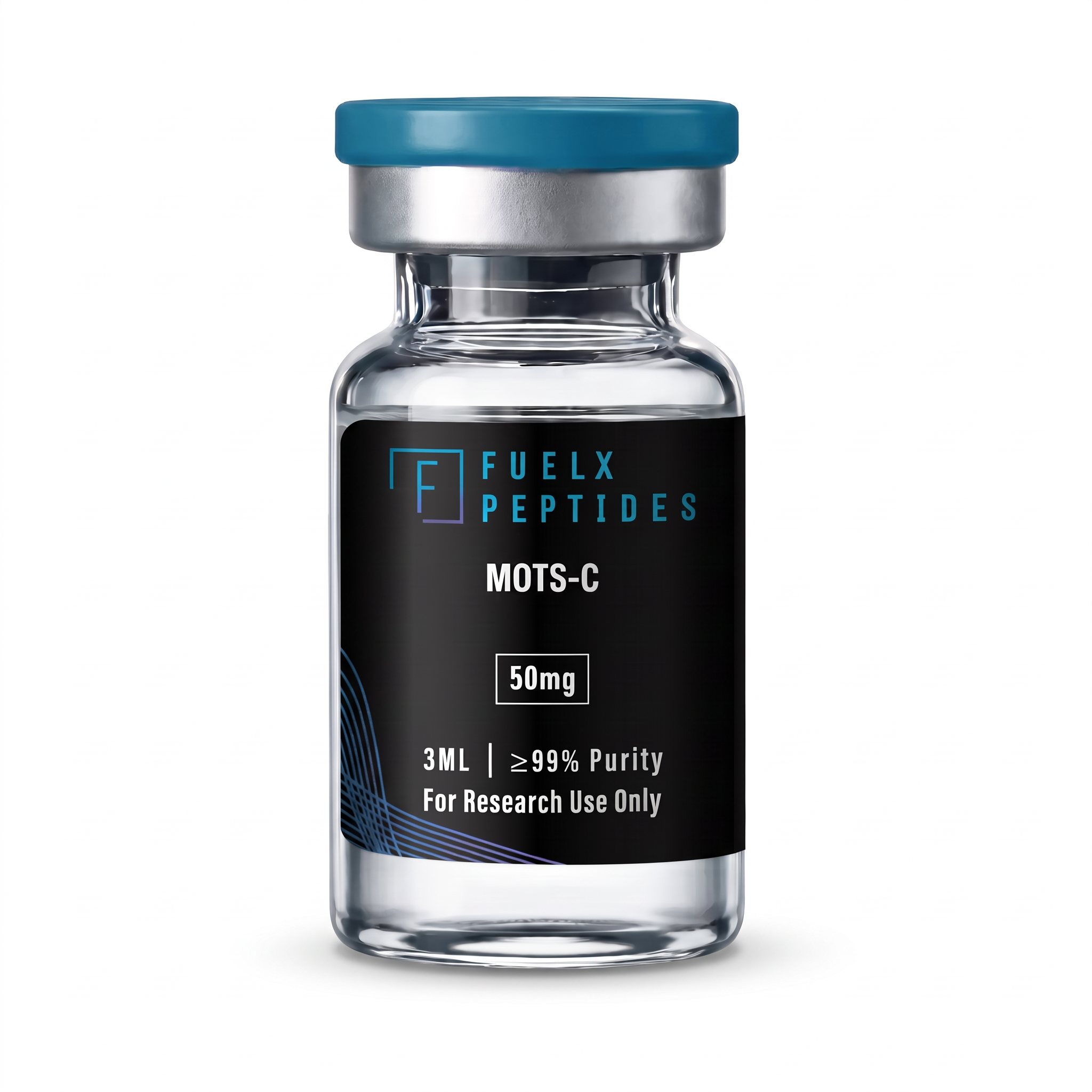
MOTS-C Research Peptide
$180.00
A mitochondria-derived research peptide (MDP) encoded within the 12S rRNA gene. Investigated for its role in intracellular metabolic regulation, AMPK activation, and mitochondria-to-nucleus communication. For research use only. Not for human consumption.
MOTS-C · lyophilized powder research material
For laboratory research use only. Not for human or veterinary use, consumption, or any diagnostic or therapeutic application.
Research Overview
MOTS-c is a synthetic research peptide consisting of a 16-amino acid sequence (Met-Arg-Trp-Gln-Glu-Met-Gly-Tyr-Ile-Phe-Tyr-Pro-Arg-Lys-Leu-Arg) that originates from a short open reading frame encoded within the mitochondrial 12S rRNA gene. Unlike nuclear-encoded peptides, MOTS-c is classified as a mitochondria-derived peptide and has been examined for its role in intracellular metabolic regulation. Preclinical research has shown that MOTS-c participates in pathways associated with cellular energy balance and mitochondrial function, including activation of AMP-activated protein kinase (AMPK). Experimental models have also explored its involvement in mitochondrial stress responses and adaptive metabolic signaling. Because of these properties, MOTS-c is frequently used in laboratory studies focused on metabolism, aging biology, and mitochondria-to-nucleus communication mechanisms.
Evidence classification: MOTS-c mechanistic findings are from cell and mouse models; human data are mainly observational measurements of endogenous levels.
Research Background
The 2015 discovery paper reported that MOTS-c affected folate-cycle and purine metabolism in cultured cells and activated AMP-activated protein kinase (AMPK). Mouse studies in the same paper examined metabolic endpoints. A 2018 study reported that MOTS-c translocates to the nucleus under metabolic stress in cell models, and a 2021 study examined its relationship to physical capacity in aging mice and measured endogenous levels in human muscle and plasma after exercise.
- Inhibition of the folate cycle and de novo purine biosynthesis, leading to AICAR accumulation and AMPK activation (in vitro).
- Stress-induced nuclear translocation and interaction with transcription factors such as NRF2 (in vitro).
- Regulation of nuclear genes containing antioxidant response elements (in vitro).
Read the full MOTS-c research overview in the FuelX Research Library.
Certificate of Analysis
A Certificate of Analysis is available on request for every product, providing clear documentation of independent testing and verified purity.
Request a COA at info@fuelxpeptides.com.
Sample COA
Sample document for reference. Lot-specific COAs are available on request.
Open PDF (opens in new tab)Storage Information
Storage conditions for the unreconstituted lyophilized material are specified in the product label and lot documentation. Refer to that documentation for the applicable temperature and handling conditions; FuelX Peptides stores material under controlled conditions prior to shipment.
Scientific References
- Lee C, Zeng J, Drew BG, et al. The mitochondrial-derived peptide MOTS-c promotes metabolic homeostasis and reduces obesity and insulin resistance. Cell Metab. 2015;21(3):443-454. [In vitro / animal] View source (opens in new tab)
- Kim KH, Son JM, Benayoun BA, Lee C. The mitochondrial-encoded peptide MOTS-c translocates to the nucleus to regulate nuclear gene expression in response to metabolic stress. Cell Metab. 2018;28(3):516-524. [In vitro] View source (opens in new tab)
- Reynolds JC, Lai RW, Woodhead JST, et al. MOTS-c is an exercise-induced mitochondrial-encoded regulator of age-dependent physical decline and muscle homeostasis. Nat Commun. 2021;12(1):470. [Animal / observational human] View source (opens in new tab)
- Lee C, et al. Cell Metabolism. 2015;21(3):443–454. Search PubMed (opens in new tab)
- Kim KH, et al. Nature Communications. 2018;9(1):4774. Search PubMed (opens in new tab)
- Lee C, et al. Cell Metabolism. 2016;23(2):303–309. Search PubMed (opens in new tab)
Related Research
Related Research Compounds
Listed for research navigation only; these compounds are not equivalent and do not produce equivalent effects.
For laboratory research use only. Not for human or veterinary use, consumption, or any diagnostic or therapeutic application.