Research Guides
BPC-157: A Research Overview
A review of the synthetic pentadecapeptide BPC-157, the laboratory models used to study it, and why nearly all published evidence remains preclinical.
Read Research Guide: BPC-157: A Research OverviewThe FuelX Research Library is an educational resource designed to help researchers better understand peptide science, analytical testing, laboratory terminology, and the methods used to evaluate research materials.
Explore compound research guides, analytical testing explanations, COA education, and laboratory resources created to make complex research concepts easier to understand.
Information provided in the FuelX Research Library is for educational and research purposes only.
15 articles shown
A review of the synthetic pentadecapeptide BPC-157, the laboratory models used to study it, and why nearly all published evidence remains preclinical.
Read Research Guide: BPC-157: A Research OverviewHow TB-500 relates to the naturally occurring protein thymosin β4, what the actin-binding research shows, and why the two should not be treated as interchangeable.
Read Research Guide: TB-500: Research & Laboratory OverviewA side-by-side comparison of two structurally unrelated peptides — their origin, size, proposed mechanisms, research models and analytical requirements.
Read Research Guide: BPC-157 vs TB-500: Differences in Laboratory ResearchAn overview of tesamorelin, a synthetic GHRH analog, covering its structure, receptor pharmacology and the controlled clinical research that distinguishes it from most research peptides.
Read Research Guide: Tesamorelin: A Research OverviewThe copper-binding tripeptide GHK: its chemistry, the cell-culture and gene-expression research behind it, and the gap between laboratory and human evidence.
Read Research Guide: GHK-Cu: Laboratory Research OverviewMOTS-c is a peptide encoded within mitochondrial DNA. Learn how it was discovered, how it signals to the nucleus in cell models, and what remains unknown.
Read Research Guide: MOTS-c: Mitochondrial Research ExplainedSS-31 (elamipretide) is a synthetic tetrapeptide that associates with cardiolipin in the inner mitochondrial membrane. Explore the research and its limits.
Read Research Guide: SS-31: Mitochondrial Research OverviewKPV is the C-terminal tripeptide of α-MSH. This guide covers its origin, transport by PepT1 in cell models, and the preclinical inflammation-signaling research.
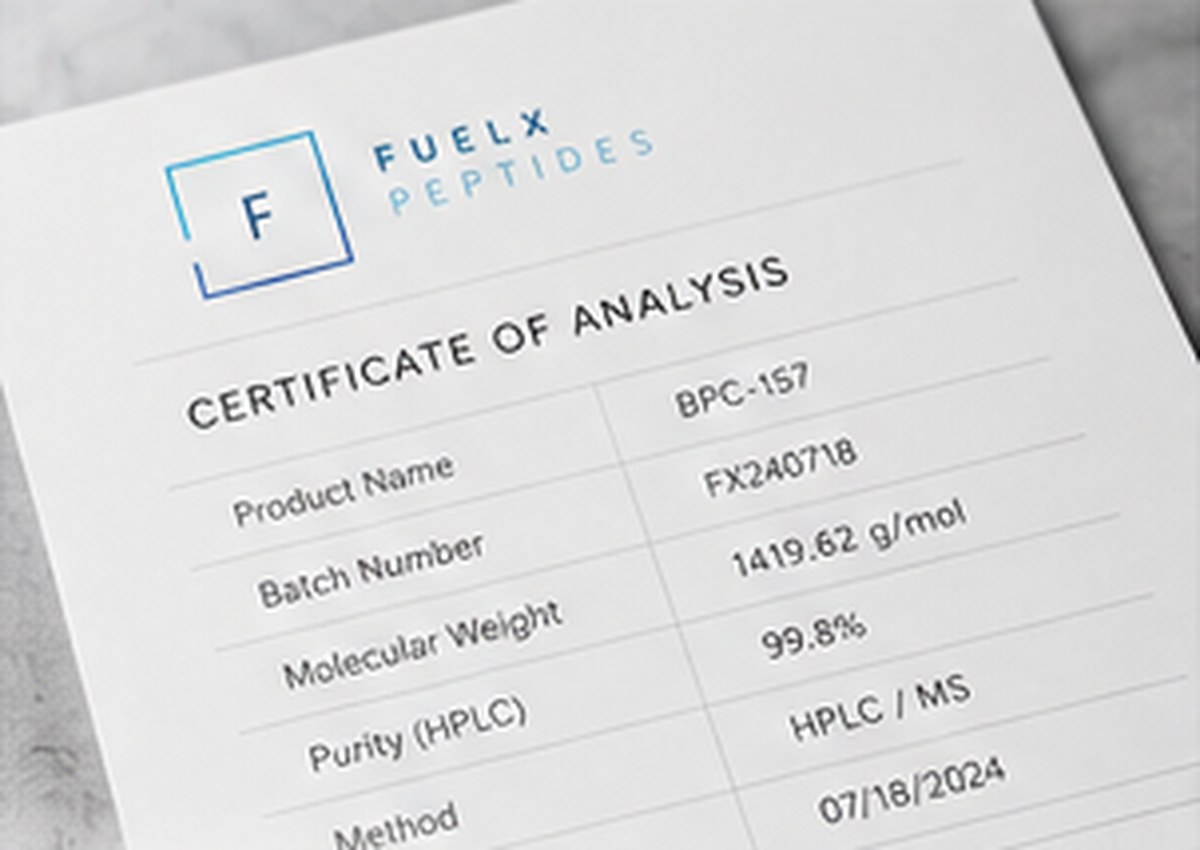
Read Research Guide: KPV: A Research OverviewA section-by-section walkthrough of a peptide Certificate of Analysis: identifiers, specifications, results, methods and what a COA cannot tell you.
Learn More: How to Read a Peptide COAWhat a purity percentage actually measures, which impurities it captures, and which it does not.
Learn More: What Does Peptide Purity Mean?How reverse-phase HPLC separates peptides, how to read a chromatogram, and what makes a purity method reliable.
Learn More: HPLC Testing ExplainedHow mass spectrometry confirms peptide identity, what m/z and charge states mean, and how MS complements HPLC.
Learn More: Mass Spectrometry Testing ExplainedWhy a 99%-pure peptide can still contain less peptide than the gross weight suggests — and how net peptide content is determined.
Learn More: Peptide Purity vs QuantityTwo frequently confused microbiological tests: what each detects, how they are performed, and why one never substitutes for the other.
Learn More: Sterility Testing vs Endotoxin TestingAn overview of freeze-drying and the analytical panel commonly applied to lyophilized peptide powders, from appearance to moisture and identity.
Learn More: How Lyophilized Peptides Are Tested