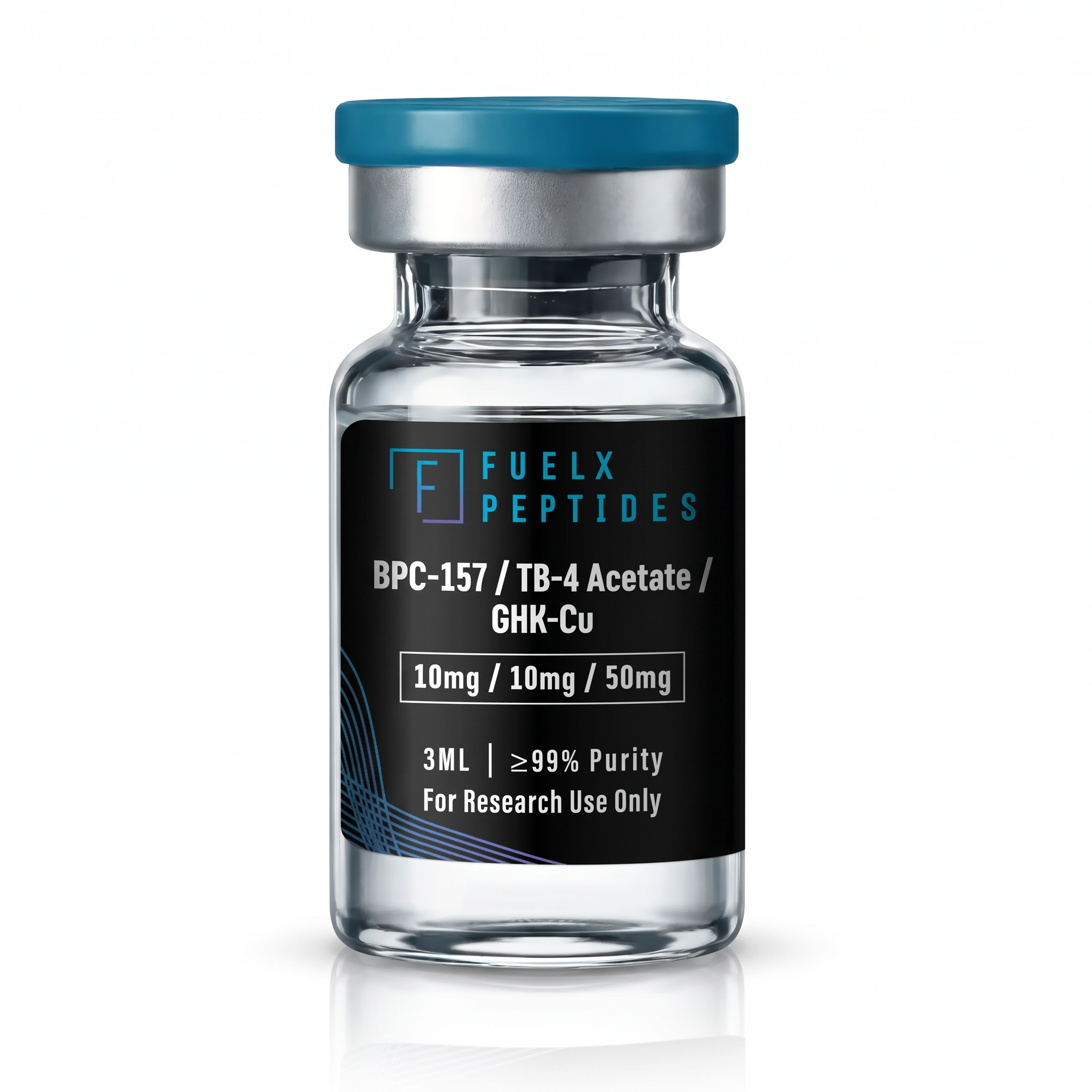
BPC-157 / TB-4 / GHK-Cu Blend Research Blend
$180.00
A three-component research blend combining BPC-157, Thymosin Beta-4 fragment, and the copper tripeptide GHK-Cu. Studied in preclinical models of cellular maintenance and tissue remodeling. For research use only. Not for human consumption.
BPC-157 / TB-4 / GHK-Cu Blend · lyophilized powder (blend) research material
For laboratory research use only. Not for human or veterinary use, consumption, or any diagnostic or therapeutic application.
Research Overview
The BPC-157 / TB-4 / GHK-Cu blend is a three-component synthetic research preparation combining a pentadecapeptide fragment derived from human gastric juice protein BPC (Body Protection Compound), an actin-binding fragment of Thymosin Beta-4, and the copper(II)-bound tripeptide Gly-His-Lys. Each constituent has been independently characterized in laboratory literature, and the blend is used experimentally to examine how these mechanisms interact within a single model system. BPC-157 has been studied in preclinical models for its interaction with growth-factor and angiogenic signaling pathways, including VEGFR2 receptor activity and nitric oxide-mediated processes. The Thymosin Beta-4 fragment is examined primarily for its actin-sequestering properties and its influence on cytoskeletal organization, cell migration, and extracellular matrix dynamics. GHK-Cu contributes a peptide–metal coordination structure investigated for copper-dependent redox chemistry, collagen organization, and regulation of gene transcription and antioxidant enzyme activity. Investigators use this combined preparation to study convergent pathways in cellular maintenance, matrix remodeling, and peptide-driven regenerative biochemistry under controlled in vitro and preclinical conditions. Because the constituents act through distinct but overlapping mechanisms, the blend is of interest in comparative research examining additive or interacting effects relative to each individual peptide. Supplied as a lyophilized powder with HPLC purity of at least 98 percent and mass-spectrometry identity confirmation; a Certificate of Analysis is available on request. For laboratory research use only. Not for human or veterinary use, consumption, or any diagnostic or therapeutic application.
Evidence classification: This is a multi-component research blend. Published literature describes the individual components, not this combination; no research establishes combined effects.
Certificate of Analysis
A Certificate of Analysis is available on request for every product, providing clear documentation of independent testing and verified purity.
Request a COA at info@fuelxpeptides.com.
Sample COA
Sample document for reference. Lot-specific COAs are available on request.
Open PDF (opens in new tab)Storage Information
Storage conditions for the unreconstituted lyophilized material are specified in the product label and lot documentation. Refer to that documentation for the applicable temperature and handling conditions; FuelX Peptides stores material under controlled conditions prior to shipment.
Scientific References
- Sikiric P, et al. Current Pharmaceutical Design. 2018;24(18):1990-2001. Search PubMed (opens in new tab)
- Chang CH, et al. Journal of Applied Physiology. 2011;110(3):774-780. Search PubMed (opens in new tab)
- Goldstein AL, Hannappel E, Kleinman HK. Trends in Molecular Medicine. 2005;11(9):421-429. Search PubMed (opens in new tab)
- Philp D, Kleinman HK. Journal of Cell Communication and Signaling. 2010;4(2):77-83. Search PubMed (opens in new tab)
- Pickart L, et al. Biochimica et Biophysica Acta. 2015;1850(8):1863-1885. Search PubMed (opens in new tab)
- Maquart FX, et al. FEBS Letters. 1988;238(2):343-346. Search PubMed (opens in new tab)
Related Research
Related Research Compounds
Listed for research navigation only; these compounds are not equivalent and do not produce equivalent effects.
For laboratory research use only. Not for human or veterinary use, consumption, or any diagnostic or therapeutic application.