BPC-157: A Research Overview
BPC-157 is a synthetic 15-amino-acid peptide derived from a sequence described in gastric juice. This guide summarizes what in vitro and animal research has examined and where the evidence ends.
Last reviewed:
Introduction
BPC-157 ("Body Protection Compound 157") is one of the most discussed research peptides, yet the published literature is concentrated in a relatively small number of research groups and is overwhelmingly preclinical. Understanding what has actually been studied — and in which experimental systems — is essential before interpreting any claim about the compound.
This overview is written for researchers. It describes the peptide, the models in which it has been examined, the mechanisms that have been proposed, and the analytical questions relevant to any laboratory working with it.
What Is BPC-157?
BPC-157 is a synthetic pentadecapeptide with the sequence Gly-Glu-Pro-Pro-Pro-Gly-Lys-Pro-Ala-Asp-Asp-Ala-Gly-Leu-Val (approximately 1419 Da). It was described as a partial sequence of a larger protein isolated from human gastric juice. The research material used in laboratories is produced by solid-phase peptide synthesis rather than isolated from a biological source.
Much of the literature reports that the peptide is comparatively stable in acidic conditions for a short linear peptide, which is one reason it was originally studied in gastrointestinal models. Stability claims should nonetheless be confirmed under the specific buffer, temperature and time conditions used in any given experiment.
Why Is It Studied?
Research interest has focused on questions of tissue response in experimental models: how cells migrate, how new blood vessels form (angiogenesis), and how signaling pathways such as nitric oxide (NO) and growth-factor receptor signaling behave after exposure to the peptide. These are fundamental cell-biology questions, and BPC-157 has been used as a tool compound to probe them.
Research Background
Most publications originate from a research group at the University of Zagreb, which has published extensively on the peptide in rodent models since the 1990s. Review articles from that group summarize findings across gastrointestinal, musculoskeletal, vascular and neurological animal models.
Independent replication by unaffiliated laboratories is more limited. This concentration of authorship does not invalidate the findings, but it is a relevant consideration when weighing the strength of the evidence base.
Evidence classification: the large majority of BPC-157 findings come from in vitro cell studies and animal (primarily rat) models. Controlled human clinical data are extremely limited and no regulatory authority has approved BPC-157 for any use.
Mechanism and Scientific Principles
No single mechanism of action has been established. Several pathways have been proposed based on laboratory findings:
- Growth-factor signaling — in vitro work in tendon fibroblasts reported increased expression of the growth hormone receptor and effects on downstream signaling (in vitro).
- Cell migration and survival — explant and cultured-cell studies reported increased fibroblast outgrowth and migration, with involvement of the FAK–paxillin pathway (in vitro).
- Angiogenesis — studies have reported changes in VEGFR2 expression and endothelial signaling in cell and animal models (in vitro / animal).
- Nitric oxide system — rodent studies describe interactions with NO-related pathways, often using NOS inhibitors or NO precursors as comparators (animal).
These are hypotheses supported by specific experimental systems. They should not be read as a demonstrated mechanism in humans.
What Laboratory Research Has Investigated
In vitro models
Cultured tendon fibroblasts and endothelial cells have been the most common in vitro systems. Endpoints include migration assays, cell spreading, survival under oxidative stress, and receptor or kinase expression measured by Western blot or PCR.
Animal models
Rodent studies have examined models of gastrointestinal lesions, tendon and ligament transection, muscle injury, and vascular occlusion. Outcomes are typically histological, biomechanical or biochemical measurements taken at defined time points. Route, vehicle and dose in these studies were chosen for the animal model and are not transferable to any other setting.
Human research
Published controlled human data are sparse. A small number of reports exist, but they do not constitute an adequate evidence base for safety or efficacy conclusions.
For a side-by-side look at how BPC-157 and thymosin β4 fragments are used differently in the laboratory, see BPC-157 vs TB-500: Differences in Laboratory Research and the TB-500 Research Overview.
Analytical and Experimental Considerations
Because BPC-157 is a short synthetic peptide, the quality of the research material directly influences reproducibility. Researchers commonly consider:
- Identity — confirmation of the expected molecular mass, usually by mass spectrometry.
- Purity — the proportion of the target peptide relative to related impurities, typically by reverse-phase HPLC. See What Does Peptide Purity Mean?.
- Net peptide content — lyophilized powders contain water and counter-ions (often acetate or TFA), so purity is not the same as quantity; see Peptide Purity vs Quantity.
- Lot documentation — a Certificate of Analysis should be tied to the specific lot used; see How to Read a Peptide COA.
Salt form (for example acetate versus arginate salts discussed in some literature) can affect solubility and stability, and should be recorded in experimental methods.
Limitations of Current Research
- Heavy reliance on rodent models, with limited independent replication.
- Few standardized dose–response or pharmacokinetic studies.
- Mechanistic studies often examine a single pathway in a single cell type.
- Negligible controlled human data; findings cannot be extrapolated to humans.
BPC-157 has also been listed by the U.S. FDA among bulk substances raising potential significant safety risks for compounding, largely because of the lack of adequate human safety data. This is a regulatory status note, not a research finding.
Frequently Asked Questions
Is BPC-157 a naturally occurring peptide?
It is described as a partial sequence of a protein found in gastric juice, but the material used in research is synthesized chemically. Whether the free 15-mer exists endogenously at meaningful levels has not been firmly established.
What type of evidence supports most BPC-157 findings?
Predominantly in vitro cell studies and rodent models. Controlled human clinical evidence is very limited.
Which analytical methods confirm BPC-157 identity?
Mass spectrometry confirms molecular mass; HPLC characterizes purity. Amino acid analysis or peptide mapping can provide additional confirmation.
Why do published results vary?
Differences in model species, vehicle, timing, endpoint measurement and material quality all contribute. Limited independent replication also makes variability harder to interpret.
Scientific References
- Chang CH, Tsai WC, Lin MS, et al. The promoting effect of pentadecapeptide BPC 157 on tendon healing involves tendon outgrowth, cell survival, and cell migration. J Appl Physiol. 2011;110(3):774-780. [In vitro / animal] View source (opens in new tab)
- Chang CH, Tsai WC, Hsu YH, Pang JH. Pentadecapeptide BPC 157 enhances the growth hormone receptor expression in tendon fibroblasts. Molecules. 2014;19(11):19066-19077. [In vitro] View source (opens in new tab)
- Seiwerth S, Rucman R, Turkovic B, et al. BPC 157 and standard angiogenic growth factors. Gastrointestinal tract healing, lessons from tendon, ligament, muscle and bone healing. Curr Pharm Des. 2018;24(18):1972-1989. [Review of preclinical research] View source (opens in new tab)
- Sikiric P, Seiwerth S, Rucman R, et al. Brain-gut axis and pentadecapeptide BPC 157: theoretical and practical implications. Curr Neuropharmacol. 2016;14(8):857-865. [Review of preclinical research] View source (opens in new tab)
- U.S. Food and Drug Administration. Certain bulk drug substances for use in compounding that may present significant safety risks. [Regulatory] View source (opens in new tab)
FuelX Research Material
Related Research

TB-500: Research & Laboratory Overview
How TB-500 relates to the naturally occurring protein thymosin β4, what the actin-binding research shows, and why the two should not be treated as interchangeable.
Read Research Guide: TB-500: Research & Laboratory Overview
BPC-157 vs TB-500: Differences in Laboratory Research
A side-by-side comparison of two structurally unrelated peptides — their origin, size, proposed mechanisms, research models and analytical requirements.
Read Research Guide: BPC-157 vs TB-500: Differences in Laboratory Research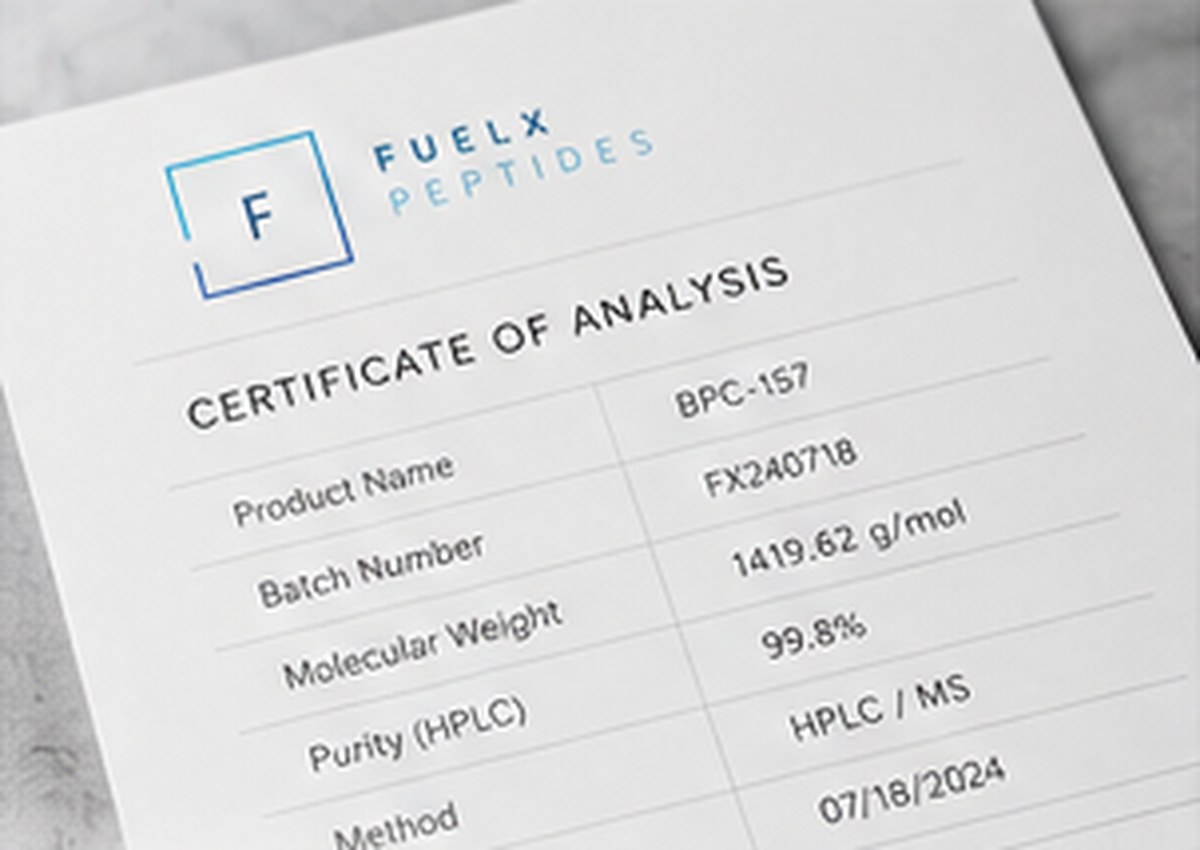
How to Read a Peptide COA
A section-by-section walkthrough of a peptide Certificate of Analysis: identifiers, specifications, results, methods and what a COA cannot tell you.
Learn More: How to Read a Peptide COAContinue Your Research
Read our testing standards to see how each compound is verified.