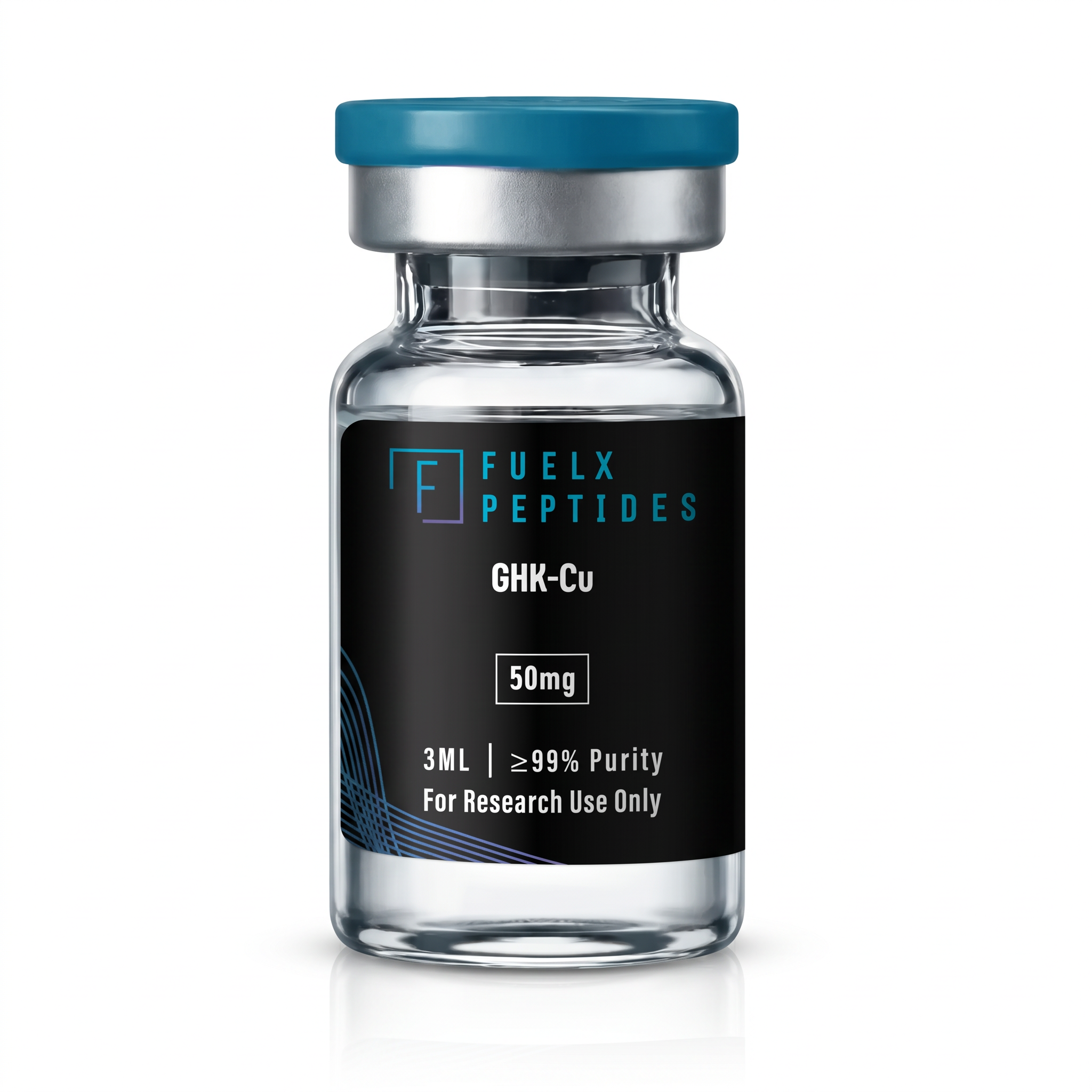
GHK-Cu Research Peptide
$55.00
A copper(II)-bound tripeptide research model studied for its interaction with metalloproteins and redox balance. Frequently evaluated for its influence on collagen organization, gene transcription, and antioxidant enzyme activity. For research use only. Not for human consumption.
GHK-Cu · lyophilized powder research material
For laboratory research use only. Not for human or veterinary use, consumption, or any diagnostic or therapeutic application.
Research Overview
GHK-Cu is a synthetic research peptide composed of the tripeptide sequence Gly-His-Lys complexed with a copper(II) ion, forming a stable peptide–metal coordination structure. This compound has been widely examined in laboratory and preclinical studies focused on cellular signaling, extracellular matrix dynamics, and metal-dependent biochemical processes. Research literature indicates that GHK-Cu interacts with pathways involved in collagen organization, gene transcription regulation, and antioxidant enzyme activity through copper-mediated redox mechanisms. Its ability to influence metalloprotein activity and matrix-related signaling has made it a commonly used model in studies of tissue remodeling and peptide-driven regenerative biochemistry. Due to its well-characterized structure and metal-binding properties, GHK-Cu continues to serve as a valuable research tool for investigating peptide–metal interactions and their role in cellular homeostasis under controlled experimental conditions.
Evidence classification: GHK-Cu findings are predominantly in vitro and animal; gene-expression associations are computational. Human evidence is limited.
Research Background
GHK was identified in 1973 as a factor in human plasma that affected the behavior of cultured liver cells. Later studies examined effects on fibroblasts, extracellular matrix components and wound models in animals. More recently, analysis of public gene-expression datasets (the Broad Institute Connectivity Map) has been used to generate hypotheses about genes whose expression changes in the presence of GHK.
- Copper coordination and possible modulation of cellular copper availability (chemistry / in vitro).
- Reported stimulation of collagen and glycosaminoglycan synthesis in cultured fibroblasts (in vitro).
- Associations with expression changes across many genes in Connectivity Map data (computational, cell-line based).
Gene-expression associations are hypothesis-generating. They do not demonstrate a functional outcome in tissue.
Read the full GHK-Cu research overview in the FuelX Research Library.
Certificate of Analysis
A Certificate of Analysis is available on request for every product, providing clear documentation of independent testing and verified purity.
Request a COA at info@fuelxpeptides.com.
Sample COA
Sample document for reference. Lot-specific COAs are available on request.
Open PDF (opens in new tab)Storage Information
Storage conditions for the unreconstituted lyophilized material are specified in the product label and lot documentation. Refer to that documentation for the applicable temperature and handling conditions; FuelX Peptides stores material under controlled conditions prior to shipment.
Scientific References
- Pickart L, Thaler MM. Tripeptide in human serum which prolongs survival of normal liver cells and stimulates growth in neoplastic liver. Nat New Biol. 1973;243(124):85-87. [In vitro] View source (opens in new tab)
- Pickart L, Margolina A. Regenerative and protective actions of the GHK-Cu peptide in the light of the new gene data. Int J Mol Sci. 2018;19(7):1987. [Review] View source (opens in new tab)
- Pickart L, Vasquez-Soltero JM, Margolina A. GHK peptide as a natural modulator of multiple cellular pathways in skin regeneration. Biomed Res Int. 2015;2015:648108. [Review] View source (opens in new tab)
- Pickart L, et al. Biochimica et Biophysica Acta. 2015;1850(8):1863–1885. Search PubMed (opens in new tab)
- Maquart FX, et al. FEBS Letters. 1988;238(2):343–346. Search PubMed (opens in new tab)
- Siméon A, et al. Journal of Investigative Dermatology. 2000;115(6):961–968. Search PubMed (opens in new tab)
Related Research
Related Research Compounds
Listed for research navigation only; these compounds are not equivalent and do not produce equivalent effects.
For laboratory research use only. Not for human or veterinary use, consumption, or any diagnostic or therapeutic application.