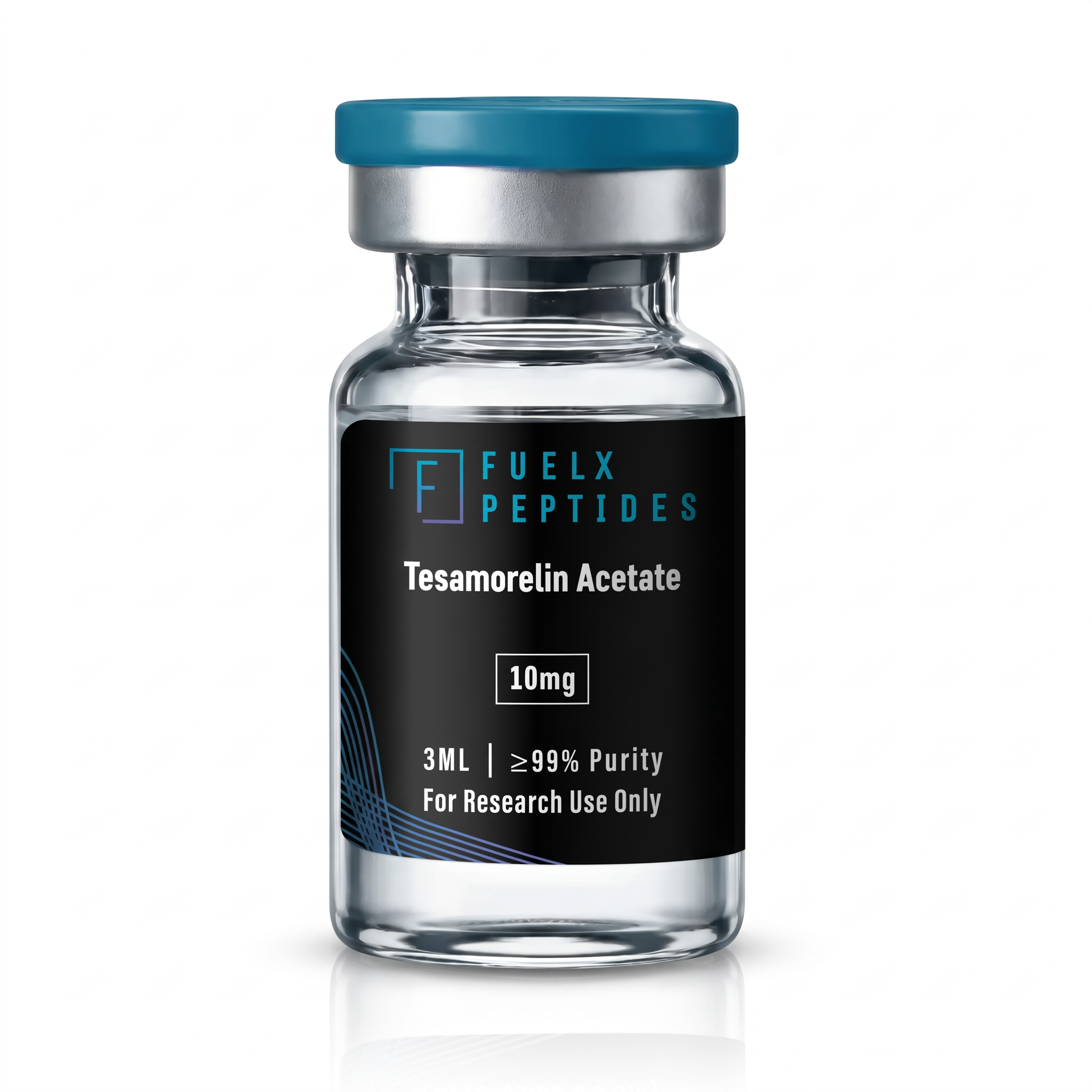
Tesamorelin Research Peptide
$80.00
A stabilized synthetic analog of GHRH with a trans-3-hexenoic acid modification. Used in research to investigate GHRH receptor dynamics and modulation of the somatotropic axis in metabolic studies. For research use only. Not for human consumption.
Tesamorelin · lyophilized powder research material
Also available: Tesamorelin 20 mg
For laboratory research use only. Not for human or veterinary use, consumption, or any diagnostic or therapeutic application.
Research Overview
Tesamorelin is a synthetic research peptide engineered as a stabilized analog of native growth hormone–releasing hormone (GHRH 1–44). Its structure includes a trans-3-hexenoic acid substitution at the second amino acid position, a modification designed to enhance peptide stability in experimental environments. In preclinical and laboratory studies, Tesamorelin interacts with GHRH receptors on pituitary somatotroph cells, initiating intracellular signaling pathways associated with growth hormone synthesis and release. Because of its defined receptor activity and improved structural stability, Tesamorelin is frequently utilized in endocrine and metabolic research exploring GHRH receptor dynamics, peptide pharmacokinetics, and modulation of the somatotropic axis under controlled experimental conditions.
Evidence classification: Tesamorelin has controlled human clinical research using an FDA-approved pharmaceutical formulation for a narrow indication. That evidence does not extend to research-grade material.
Research Background
Phase 3 randomized, placebo-controlled trials published in 2007 and later examined the pharmaceutical formulation in a specific adult population with HIV-associated abdominal fat accumulation, leading to FDA approval in 2010 for that indication. Subsequent controlled studies examined hepatic fat measurements in related populations.
Tesamorelin binds the GHRH receptor, a class B G-protein-coupled receptor on pituitary somatotrophs. Receptor activation increases cAMP and stimulates synthesis and release of growth hormone. GH in turn stimulates hepatic IGF-1 production, which exerts negative feedback. Because endogenous feedback remains intact, GHRH-receptor agonism is mechanistically distinct from exogenous GH.
Read the full Tesamorelin research overview in the FuelX Research Library.
Certificate of Analysis
A Certificate of Analysis is available on request for every product, providing clear documentation of independent testing and verified purity.
Request a COA at info@fuelxpeptides.com.
Storage Information
Storage conditions for the unreconstituted lyophilized material are specified in the product label and lot documentation. Refer to that documentation for the applicable temperature and handling conditions; FuelX Peptides stores material under controlled conditions prior to shipment.
Scientific References
- Falutz J, Allas S, Blot K, et al. Metabolic effects of a growth hormone-releasing factor in patients with HIV. N Engl J Med. 2007;357(23):2359-2370. [Controlled human clinical] View source (opens in new tab)
- Stanley TL, Fourman LT, Feldpausch MN, et al. Effect of tesamorelin on visceral fat and liver fat in HIV-infected patients with abdominal fat accumulation: a randomized clinical trial. JAMA. 2014;312(4):380-389. [Controlled human clinical] View source (opens in new tab)
- U.S. National Library of Medicine. DailyMed: EGRIFTA (tesamorelin) prescribing information. [Regulatory labeling] View source (opens in new tab)
- Falutz J, et al. Annals of Internal Medicine. 2010;152(5):323–331. Search PubMed (opens in new tab)
- Gelato MC, et al. Journal of Clinical Endocrinology & Metabolism. 2005;90(9):5247–5253. Search PubMed (opens in new tab)
Related Research
Related Research Compounds
Listed for research navigation only; these compounds are not equivalent and do not produce equivalent effects.
For laboratory research use only. Not for human or veterinary use, consumption, or any diagnostic or therapeutic application.