Peptide Purity vs Quantity
Purity and quantity answer different questions. This article explains gross weight, net peptide content, counter-ions and water, and how each is measured.
Last reviewed:
Introduction
A lyophilized peptide powder is never 100% peptide by weight. Understanding why is important for accurate experimental calculations and for reading documentation correctly.
Three Different Numbers
- Gross weight — the total mass of powder.
- Purity — the fraction of UV-absorbing material that is the target peptide (by HPLC).
- Net peptide content (NPC) — the fraction of gross weight that is peptide of any sequence.
Target peptide mass ≈ gross weight × NPC × purity.
What Makes Up the Non-Peptide Mass?
Counter-ions
Basic residues (Lys, Arg, His) and the N-terminus carry positive charges balanced by anions from purification — commonly TFA or acetate. Highly basic peptides can carry substantial counter-ion mass.
Water
Lyophilized peptides are hygroscopic and retain residual moisture, measured by Karl Fischer titration (USP <921>).
Salts and residuals
Minor inorganic salts or residual solvents may also be present.
How Net Peptide Content Is Measured
Amino acid analysis (USP <1052>) hydrolyzes the peptide and quantifies the amino acids, giving an absolute peptide amount. Elemental nitrogen analysis is an alternative. Some laboratories calculate NPC from separately measured water and counter-ion content.
Worked Example
Consider 10.0 mg gross powder with 80% NPC and 99% purity. Peptide of any sequence ≈ 8.0 mg; target peptide ≈ 7.9 mg. The "99%" figure is accurate, but it does not mean 9.9 mg of target peptide is present.
Limitations
Not every COA reports NPC. When it is absent, researchers should not assume the labeled amount equals target peptide mass. See How to Read a Peptide COA and What Does Peptide Purity Mean?.
Frequently Asked Questions
Why doesn't purity account for water?
HPLC-UV detects UV-absorbing species; water does not absorb at the detection wavelength and is not integrated.
What is a typical net peptide content?
It varies with sequence and salt form. Laboratory measurement is required; it should not be assumed.
Does TFA vs acetate matter?
Yes. It changes counter-ion mass and can influence some cell-based assays, so salt form should be recorded.
Scientific References
- United States Pharmacopeia. General Chapter <1052> Biotechnology-Derived Articles — Amino Acid Analysis. [Compendial standard] View source (opens in new tab)
- United States Pharmacopeia. General Chapter <921> Water Determination. [Compendial standard] View source (opens in new tab)
- U.S. FDA. ANDAs for Certain Highly Purified Synthetic Peptide Drug Products That Refer to Listed Drugs of rDNA Origin: Guidance for Industry. 2021. [Regulatory guidance] View source (opens in new tab)
Related Research
What Does Peptide Purity Mean?
What a purity percentage actually measures, which impurities it captures, and which it does not.
Learn More: What Does Peptide Purity Mean?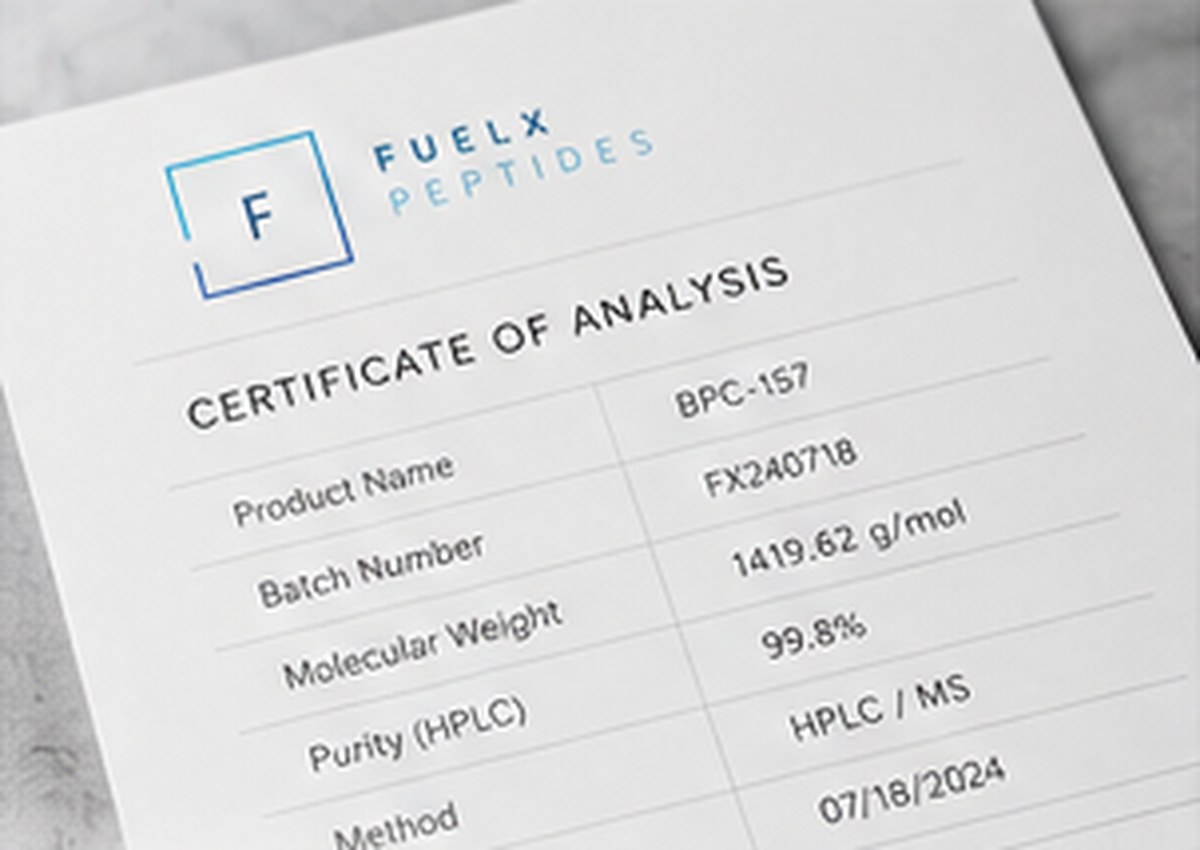
How to Read a Peptide COA
A section-by-section walkthrough of a peptide Certificate of Analysis: identifiers, specifications, results, methods and what a COA cannot tell you.
Learn More: How to Read a Peptide COA
How Lyophilized Peptides Are Tested
An overview of freeze-drying and the analytical panel commonly applied to lyophilized peptide powders, from appearance to moisture and identity.
Learn More: How Lyophilized Peptides Are TestedContinue Your Research
Read our testing standards to see how each compound is verified.