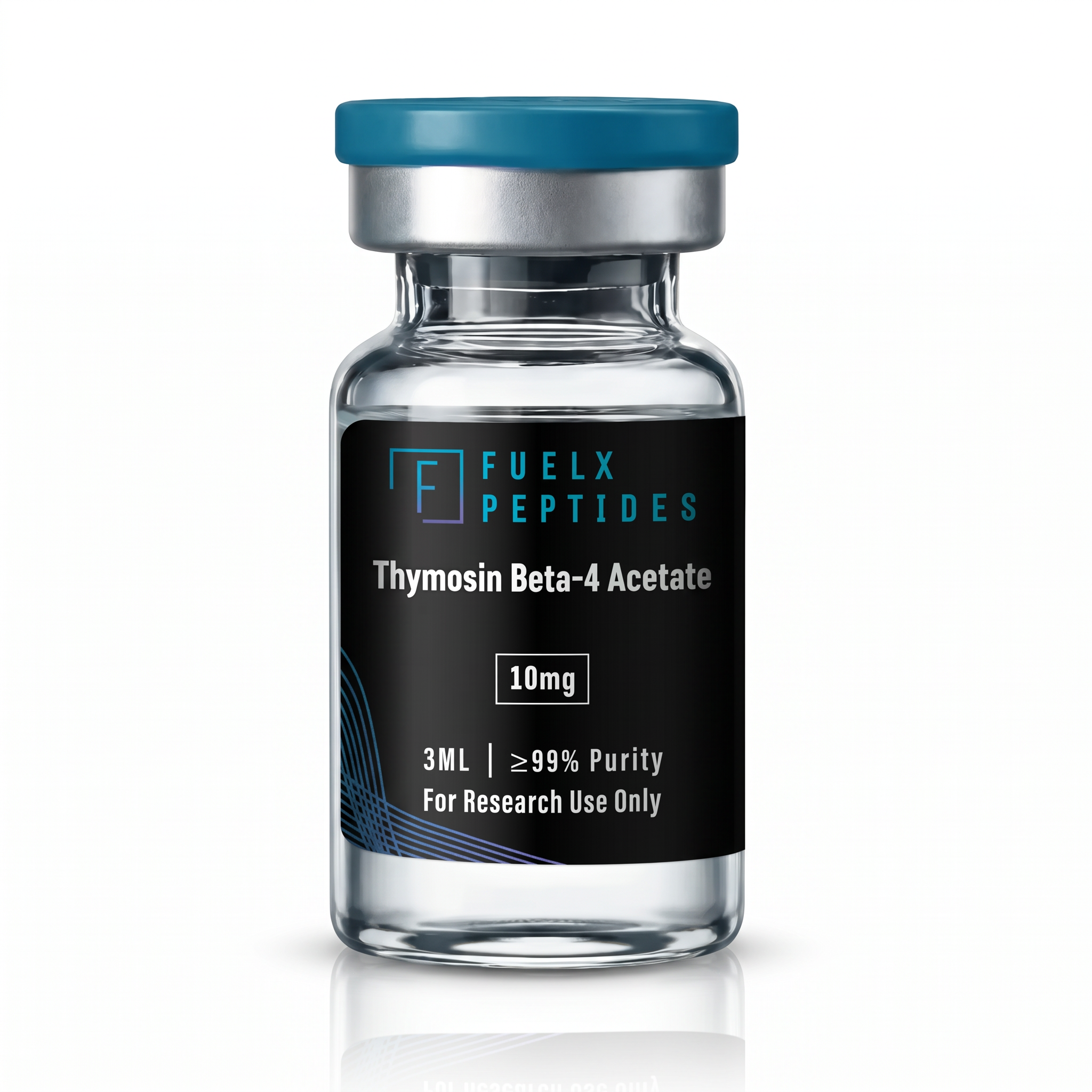
TB-500 (Thymosin Beta-4) Research Peptide
$130.00
A synthetic version of the full 43-amino acid Thymosin Beta-4 peptide. Studied for its role in actin sequestration and cytoskeletal dynamics; a key research model for cell migration and tissue remodeling. For research use only. Not for human consumption.
TB-500 (Thymosin Beta-4) · lyophilized powder research material
For laboratory research use only. Not for human or veterinary use, consumption, or any diagnostic or therapeutic application.
Research Overview
TB-500 is a synthetic research peptide representing the full 43–amino acid sequence of Thymosin Beta-4, a naturally occurring peptide recognized for its role in actin dynamics and cellular structure. In laboratory and preclinical models, TB-500 has been examined for its interaction with cytoskeletal components, particularly its regulation of the equilibrium between monomeric (G-actin) and filamentous (F-actin) forms. Published studies indicate that TB-500 participates in processes related to cell migration, angiogenic signaling, and tissue organization through modulation of actin polymerization and associated growth factor pathways. Because of these characteristics, TB-500 is commonly utilized as a research tool in investigations focused on cellular motility, wound-healing mechanisms, and peptide-mediated regenerative biology under controlled experimental conditions.
Evidence classification: Thymosin β4 research is primarily in vitro and animal; early-phase human studies of specific formulations are limited and do not establish safety or efficacy.
Research Background
Tβ4 was originally isolated from thymus tissue ("thymosin fraction 5") and later recognized as widely expressed. Foundational biochemistry in the 1990s characterized its actin-binding properties. Subsequent work, including a widely cited 2007 study in Nature, examined Tβ4 in mouse cardiac models and embryonic development.
The N-terminal tetrapeptide Ac-SDKP, which can be released from Tβ4 by prolyl oligopeptidase, is a separate bioactive peptide with its own research literature.
Actin sequestration
Tβ4 binds G-actin in a 1:1 complex, reducing polymerization. This is the best-established biochemical property and is supported by extensive in vitro biochemistry.
Cell migration and signaling
Cell studies report effects on migration of endothelial cells and keratinocytes, and interactions with signaling proteins such as integrin-linked kinase (ILK). These observations come from defined in vitro systems.
Fragment-specific activity
Different regions of the molecule have been associated with different activities in laboratory models; the actin-binding central domain and the Ac-SDKP N-terminus are the most frequently discussed.
Read the full TB-500 research overview in the FuelX Research Library.
Certificate of Analysis
A Certificate of Analysis is available on request for every product, providing clear documentation of independent testing and verified purity.
Request a COA at info@fuelxpeptides.com.
Storage Information
Storage conditions for the unreconstituted lyophilized material are specified in the product label and lot documentation. Refer to that documentation for the applicable temperature and handling conditions; FuelX Peptides stores material under controlled conditions prior to shipment.
Scientific References
- Huff T, Müller CS, Otto AM, Netzker R, Hannappel E. β-Thymosins, small acidic peptides with multiple functions. Int J Biochem Cell Biol. 2001;33(3):205-220. [Review / in vitro] View source (opens in new tab)
- Goldstein AL, Hannappel E, Sosne G, Kleinman HK. Thymosin β4: a multi-functional regenerative peptide. Basic properties and clinical applications. Expert Opin Biol Ther. 2012;12(1):37-51. [Review] View source (opens in new tab)
- Smart N, Risebro CA, Melville AA, et al. Thymosin β4 induces adult epicardial progenitor mobilization and neovascularization. Nature. 2007;445(7124):177-182. [Animal] View source (opens in new tab)
- Bock-Marquette I, Saxena A, White MD, DiMaio JM, Srivastava D. Thymosin β4 activates integrin-linked kinase and promotes cardiac cell migration, survival and cardiac repair. Nature. 2004;432(7016):466-472. [In vitro / animal] View source (opens in new tab)
- Huff T, et al. Journal of Molecular Biology. 2001;312(3):593–606. Search PubMed (opens in new tab)
- Malinda KM, et al. FASEB Journal. 1999;13(14):2106–2114. Search PubMed (opens in new tab)
Related Research
Related Research Compounds
Listed for research navigation only; these compounds are not equivalent and do not produce equivalent effects.
For laboratory research use only. Not for human or veterinary use, consumption, or any diagnostic or therapeutic application.