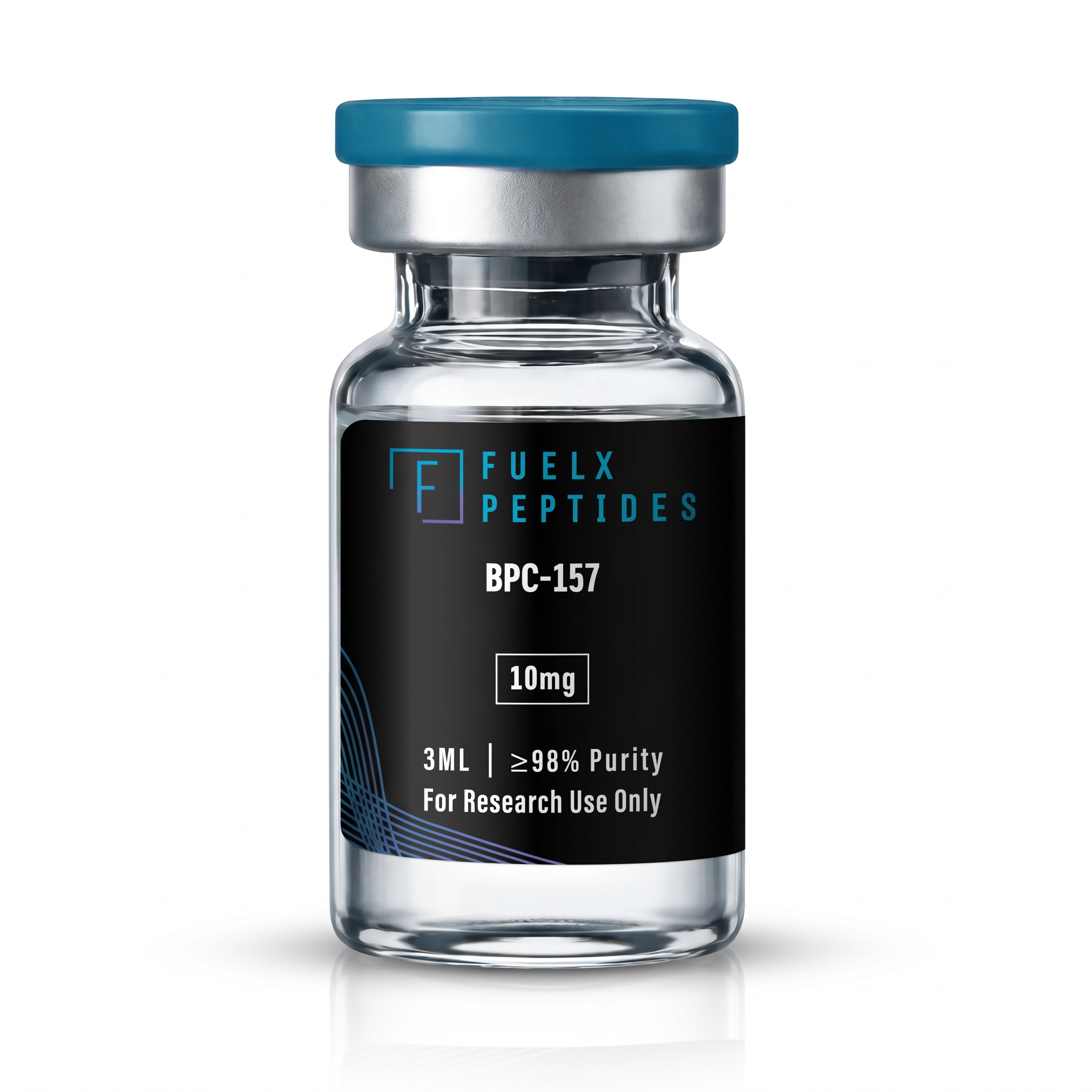
BPC-157 Research Peptide
$80.00
A 15-amino acid research peptide derived from gastric body protection compounds. Studied experimentally for its influence on angiogenic signaling, nitric oxide pathways, and extracellular matrix remodeling under controlled laboratory conditions.
BPC-157 · lyophilized powder research material
For laboratory research use only. Not for human or veterinary use, consumption, or any diagnostic or therapeutic application.
Research Overview
BPC-157 is a research peptide composed of 15 amino acids (Gly-Glu-Pro-Pro-Pro-Gly-Lys-Pro-Ala-Asp-Asp-Ala-Gly-Leu-Val), a fragment of the body protection compound found in gastric juice. Experimental data suggest it influences angiogenic and cytoprotective signaling through modulation of nitric oxide pathways, growth factor expression, and extracellular matrix remodeling. These actions make it a useful model for studying molecular repair and regenerative processes under stress conditions.
Evidence classification: Published research on this compound is predominantly in vitro and animal (preclinical). Controlled human clinical evidence is limited or absent.
Research Background
Most publications originate from a research group at the University of Zagreb, which has published extensively on the peptide in rodent models since the 1990s. Review articles from that group summarize findings across gastrointestinal, musculoskeletal, vascular and neurological animal models.
Independent replication by unaffiliated laboratories is more limited. This concentration of authorship does not invalidate the findings, but it is a relevant consideration when weighing the strength of the evidence base.
No single mechanism of action has been established. Several pathways have been proposed based on laboratory findings:
- Growth-factor signaling — in vitro work in tendon fibroblasts reported increased expression of the growth hormone receptor and effects on downstream signaling (in vitro).
- Cell migration and survival — explant and cultured-cell studies reported increased fibroblast outgrowth and migration, with involvement of the FAK–paxillin pathway (in vitro).
- Angiogenesis — studies have reported changes in VEGFR2 expression and endothelial signaling in cell and animal models (in vitro / animal).
- Nitric oxide system — rodent studies describe interactions with NO-related pathways, often using NOS inhibitors or NO precursors as comparators (animal).
These are hypotheses supported by specific experimental systems. They should not be read as a demonstrated mechanism in humans.
Read the full BPC-157 research overview in the FuelX Research Library.
Certificate of Analysis
A Certificate of Analysis is available on request for every product, providing clear documentation of independent testing and verified purity.
Request a COA at info@fuelxpeptides.com.
Sample COA
Sample document for reference. Lot-specific COAs are available on request.
Open PDF (opens in new tab)Storage Information
Storage conditions for the unreconstituted lyophilized material are specified in the product label and lot documentation. Refer to that documentation for the applicable temperature and handling conditions; FuelX Peptides stores material under controlled conditions prior to shipment.
Scientific References
- Chang CH, Tsai WC, Lin MS, et al. The promoting effect of pentadecapeptide BPC 157 on tendon healing involves tendon outgrowth, cell survival, and cell migration. J Appl Physiol. 2011;110(3):774-780. [In vitro / animal] View source (opens in new tab)
- Chang CH, Tsai WC, Hsu YH, Pang JH. Pentadecapeptide BPC 157 enhances the growth hormone receptor expression in tendon fibroblasts. Molecules. 2014;19(11):19066-19077. [In vitro] View source (opens in new tab)
- Seiwerth S, Rucman R, Turkovic B, et al. BPC 157 and standard angiogenic growth factors. Gastrointestinal tract healing, lessons from tendon, ligament, muscle and bone healing. Curr Pharm Des. 2018;24(18):1972-1989. [Review of preclinical research] View source (opens in new tab)
- Sikiric P, Seiwerth S, Rucman R, et al. Brain-gut axis and pentadecapeptide BPC 157: theoretical and practical implications. Curr Neuropharmacol. 2016;14(8):857-865. [Review of preclinical research] View source (opens in new tab)
- U.S. Food and Drug Administration. Certain bulk drug substances for use in compounding that may present significant safety risks. [Regulatory] View source (opens in new tab)
- Sikiric P et al., Curr Pharm Des, 2018;24(18):2002–2030 Search PubMed (opens in new tab)
- Kang EA et al., Dig Dis Sci, 2013;58:3310–3317 Search PubMed (opens in new tab)
- Seiwerth S et al., Biomedicines, 2018;6(3):75 Search PubMed (opens in new tab)
Related Research
Related Research Compounds
Listed for research navigation only; these compounds are not equivalent and do not produce equivalent effects.
For laboratory research use only. Not for human or veterinary use, consumption, or any diagnostic or therapeutic application.