HPLC Testing Explained
High-performance liquid chromatography (HPLC) is the standard method for assessing peptide purity. This guide explains the principles, the chromatogram, and method validation.
Last reviewed:
Introduction
Almost every peptide purity figure comes from HPLC. Understanding the technique makes it possible to evaluate a chromatogram rather than simply accept a percentage.
What Is HPLC?
HPLC pumps a liquid mobile phase at high pressure through a column packed with small particles (the stationary phase). Components in the sample interact differently with the stationary phase and therefore exit the column (elute) at different times, called retention times.
Scientific Principles: Reverse-Phase Separation
For peptides, reverse-phase HPLC (RP-HPLC) is standard. The stationary phase is hydrophobic (often C18-bonded silica); the mobile phase starts mostly aqueous and becomes increasingly organic (usually acetonitrile) over a gradient. More hydrophobic peptides are retained longer. An ion-pairing agent such as 0.1% TFA sharpens peptide peaks.
Detection
UV detection at 214–220 nm captures peptide-bond absorbance. Some methods add 280 nm for aromatic residues or couple the HPLC to a mass spectrometer.
Reading a Chromatogram
- X-axis: retention time (minutes).
- Y-axis: detector response (absorbance).
- Main peak: the target peptide.
- Smaller peaks: related impurities or artifacts.
- Purity = main-peak area ÷ total integrated area × 100.
Look for a stable baseline, a symmetrical main peak, and resolution between the main peak and nearby impurities. How this figure is interpreted is covered in What Does Peptide Purity Mean?.
Method Reliability
USP <621> describes system suitability parameters such as resolution, tailing factor and repeatability. ICH Q2(R2) describes validation characteristics — specificity, linearity, accuracy, precision and range — used to show a method is fit for purpose.
Limitations
HPLC cannot identify a peak on its own; retention time alone is not proof of identity. It also does not detect water or counter-ions, which is why purity differs from quantity.
Frequently Asked Questions
Why is TFA used in peptide HPLC?
It acts as an ion-pairing agent that improves peak shape and resolution for peptides.
Does a single peak guarantee purity?
No. Co-eluting impurities can hide under a single peak; orthogonal methods such as LC-MS help detect them.
What is system suitability?
A set of checks, run with each analysis, confirming the chromatographic system performs adequately at the time of testing.
Scientific References
- United States Pharmacopeia. General Chapter <621> Chromatography. [Compendial standard] View source (opens in new tab)
- International Council for Harmonisation. ICH Q2(R2): Validation of Analytical Procedures. 2023. [Standards guidance] View source (opens in new tab)
Related Research
What Does Peptide Purity Mean?
What a purity percentage actually measures, which impurities it captures, and which it does not.
Learn More: What Does Peptide Purity Mean?
Mass Spectrometry Testing Explained
How mass spectrometry confirms peptide identity, what m/z and charge states mean, and how MS complements HPLC.
Learn More: Mass Spectrometry Testing Explained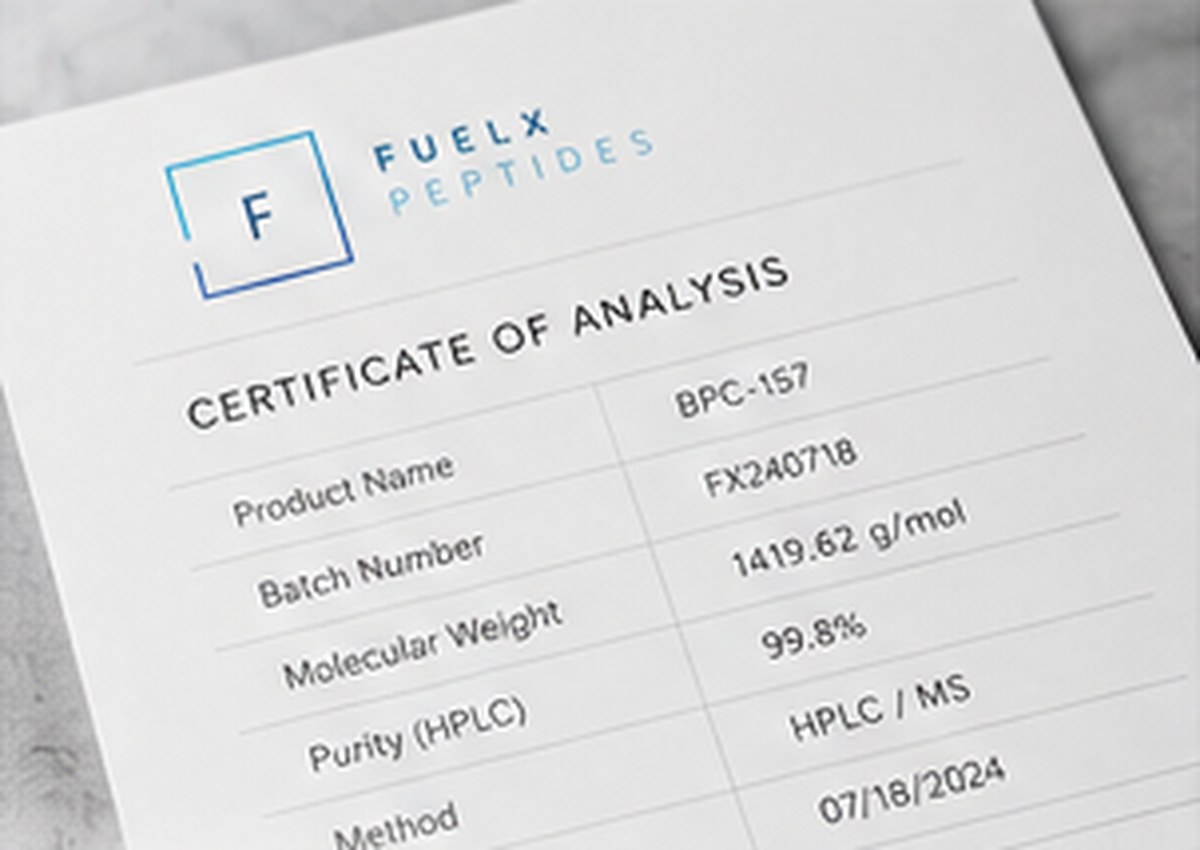
How to Read a Peptide COA
A section-by-section walkthrough of a peptide Certificate of Analysis: identifiers, specifications, results, methods and what a COA cannot tell you.
Learn More: How to Read a Peptide COAContinue Your Research
Read our testing standards to see how each compound is verified.